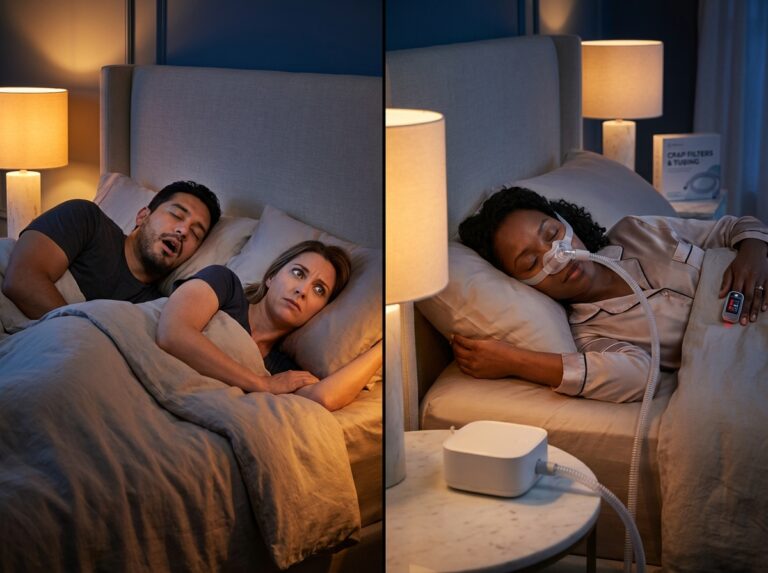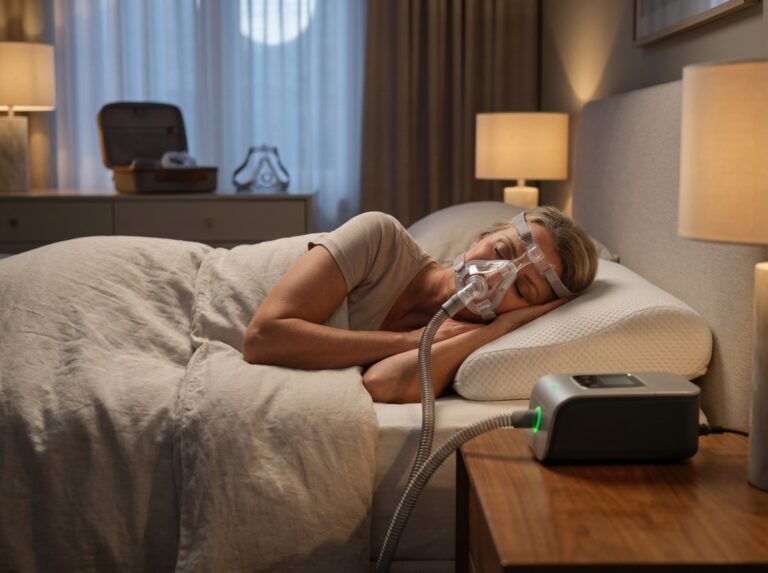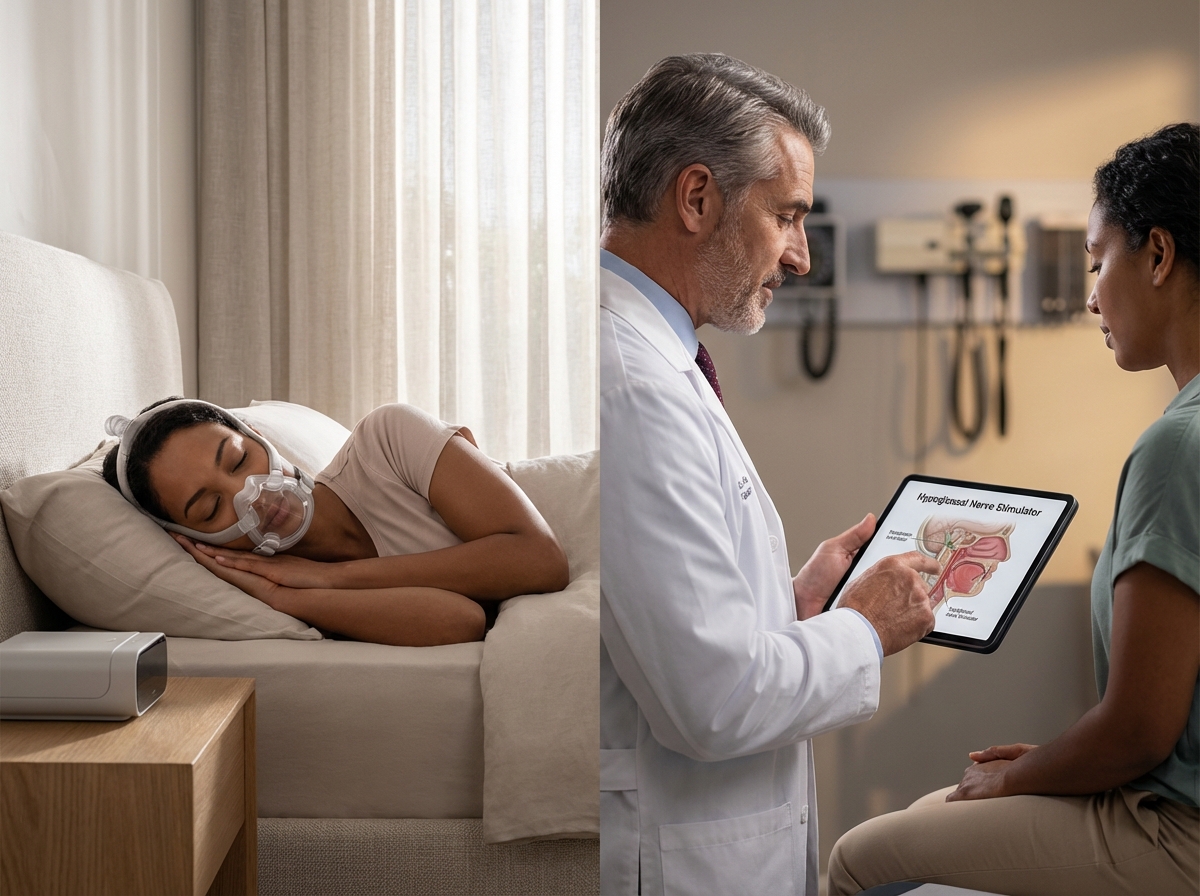
Many people with obstructive sleep apnea struggle with CPAP adherence. This article explores hypoglossal nerve stimulation with the Inspire implant as a surgical alternative, comparing outcomes, safety, candidacy, and costs. Read on for evidence-based guidance to help patients and clinicians decide whether Inspire is a realistic long-term solution or if optimizing CPAP and other therapies remains the best approach.
Why CPAP is the Standard and Why Patients Stop Using It
Obstructive sleep apnea is a physical struggle that happens every time the sun goes down. When a person with this condition falls asleep, the muscles in their throat relax more than they should. The tongue and soft tissues at the back of the throat collapse backward due to gravity. This creates a physical block in the airway. Breathing stops for ten seconds or longer. The brain eventually realizes it is suffocating and sends a jolt of adrenaline to wake the body up just enough to gasp for air. This cycle repeats dozens or even hundreds of times in a single night. It prevents the deep sleep necessary for the body to repair itself. It puts a massive strain on the heart because oxygen levels in the blood drop sharply while blood pressure spikes.
Doctors measure the severity of this condition using the Apnea-Hypopnea Index (AHI). This is a number that represents how many times per hour a person stops breathing or has restricted airflow. Mild sleep apnea involves 5 to 15 events per hour. Moderate sleep apnea ranges from 15 to 30 events. Severe sleep apnea is anything over 30 events every hour. A person with severe apnea might stop breathing every two minutes all night long. This leads to a high score on the Epworth Sleepiness Scale. This scale is a questionnaire where patients rate how likely they are to fall asleep during daily activities. Scores of 10 or higher usually mean a person is dealing with excessive daytime sleepiness that interferes with work or driving.
The medical community considers Continuous Positive Airway Pressure (CPAP) the gold standard for treatment. It is an evidence-based first-line therapy because it works like a pneumatic splint. The machine blows a steady stream of filtered air through a mask to keep the throat open. When used correctly, it is incredibly effective. It can reduce an index of 40 down to less than 5 in a single night. Clinical literature shows that successful use leads to significant cardiovascular benefits. It lowers the risk of heart failure. It improves insulin sensitivity for those with metabolic issues. Patients often report feeling a fog lift from their brain within days of starting treatment.
The public health impact of leaving this condition untreated is staggering. It is linked to a higher risk of stroke and coronary artery disease. It is a leading cause of motor vehicle accidents due to driver fatigue. Despite these dangers, the reality of treatment is complicated. Meta-analyses through 2024 and 2025 show that real-world adherence is much lower than doctors hope. Many studies report that patients only use their machines for 3 to 5 hours a night. This is below the 4-hour threshold that many insurance companies require for reimbursement. Global adherence rates often hover around 55 percent after the first year. This means nearly half of all patients are not getting the protection they need.
There are many reasons why people stop using their machines. Mask discomfort is the most common complaint. Some people develop skin irritation or pressure sores where the silicone touches their face. Claustrophobia is another major barrier. Feeling a mask strapped to the face while air is forced into the lungs can trigger panic. Air leaks are noisy and can blow into the eyes. This wakes up the patient and their partner. Some people struggle with pressure intolerance. They feel like they are fighting against the machine to exhale. Aerophagia, which is swallowing air, causes painful bloating and gas in the morning. There are also practical issues. Traveling with a machine is a chore. Cleaning the hoses and tanks takes time. Some patients feel a sense of stigma or embarrassment about wearing a mask in front of a partner.
| OSA Severity Category | AHI Range (Events per Hour) | Typical Health Risks |
|---|---|---|
| Mild | 5 to 15 | Daytime fatigue and mood changes |
| Moderate | 15 to 30 | Increased blood pressure and heart strain |
| Severe | Greater than 30 | High risk of stroke and heart attack |
When a patient uses their machine for only two or three hours, they leave themselves vulnerable for the rest of the night. Most REM sleep happens in the early morning hours. This is when muscles are most relaxed and apnea events are often at their worst. Suboptimal use undermines all the health benefits. It keeps the body in a state of chronic inflammation. This is why finding alternatives is a clinical priority. The American Academy of Sleep Medicine suggests that we must look for other paths when a patient cannot tolerate the standard treatment. If the mask is sitting in a closet, it is not saving a life. This brings us to a vital clinical question. When should we stop trying to fix the mask and start looking at surgical options or implants? For many, the Inspire Implant vs. CPAP debate becomes the next logical step in their journey toward better health.
How the Inspire Hypoglossal Nerve Stimulator Works
The transition from a bedside machine to an internal implant marks a significant shift in how we approach obstructive sleep apnea. This technology moves away from the mechanical force of air and instead focuses on the biological movement of the tongue. The system functions as a pacemaker for the airway by delivering mild electrical pulses to the hypoglossal nerve. This nerve controls the genioglossus muscle, which is the primary muscle responsible for pushing the tongue forward. When the device activates, it prevents the tongue and soft tissues from falling backward and blocking the throat during sleep.
System Components and Hardware
The traditional setup (Inspire IV) consists of three main parts. First, an implantable pulse generator sits in a subcutaneous pocket in the upper right chest. This serves as the brain of the device. Second, a stimulation lead travels from the generator to the hypoglossal nerve in the neck. Third, a sensing lead is placed between the ribs to detect breathing patterns. However, the technology has advanced significantly by late 2025. The newer Inspire V system has simplified this architecture. It integrates the respiratory sensor directly into the chest generator. This change reduces the number of components from three to two and eliminates the need for a separate incision in the rib area. Patients also receive a handheld remote to turn the therapy on before bed and off upon waking.
The Surgical Procedure and Recovery
Implantation occurs under general anesthesia in an outpatient or overnight hospital setting. For the latest models, surgeons typically make two small incisions. One incision is in the upper neck to access the hypoglossal nerve and the other is in the upper chest for the generator. The procedure usually takes between 60 and 120 minutes. Recent data from 2025 indicates that the newer integrated sensor models have reduced operative times by approximately 20 percent. Most patients return home within 24 hours. The recovery period focuses on wound healing for about four to six weeks. During this time, the device remains turned off to allow the leads to stabilize in the tissue. Physical activity is often restricted for a few weeks to prevent lead migration.
Activation and Titration Protocols
The device is not ready for use immediately after surgery. A clinician activates the system about a month later during an office visit. This starts the titration phase. The goal is to find a stimulation level that is strong enough to open the airway but gentle enough not to wake the patient. The sensation is typically described as a mild contraction or pulse, not pain. Many centers use an in-lab sleep study to fine-tune these settings. During this study, technicians adjust the voltage and pulse width while monitoring the apnea-hypopnea index in real time. Patients have some control over their therapy; they can use the remote to adjust the intensity within a pre-set range. This flexibility helps users acclimate to the sensation of the tongue moving while they sleep.
Device Lifecycle and Maintenance
The implant is a long-term commitment with specific maintenance needs. The battery in the pulse generator typically lasts between 8 and 11 years. Once the battery nears the end of its life, a surgeon must replace the generator through a minor procedure. The leads usually remain in place during this exchange. Modern versions of the device are MRI-conditional. This means patients can undergo MRI scans as long as specific safety protocols are followed, provided they carry their device identification card to inform medical staff. Regular check-ups once or twice a year ensure the system is functioning correctly and the settings remain optimized for the patient’s changing needs.
Effectiveness and Safety Compared to CPAP
When we look at how well these treatments work, we have to separate perfect laboratory use from what happens in a real bedroom. CPAP remains the gold standard for clearing the airway. When a patient wears the mask as prescribed, it can reduce the Apnea-Hypopnea Index (AHI) to nearly zero. The problem is that many people cannot keep the mask on all night. Real-world data shows that average CPAP use often sits between three and five hours per night. This leaves many hours of sleep completely untreated.
Clinical Effectiveness and the STAR Trial
AHI Reduction and Success Rates
The Inspire system takes a different approach. It does not always reach the near-zero AHI levels that a perfectly used CPAP machine can achieve. However, it offers much more consistency. The landmark STAR trial followed patients who could not tolerate CPAP. At the 12-month mark, the median AHI reduction was approximately 68 percent. About 66 percent of participants met the criteria for a successful response. This means their AHI dropped by at least half and stayed below 20 events per hour. Long-term data published through 2024 and 2025 confirms these results are durable. Five-year follow-up studies from the STAR trial show that patients who continue using the device maintain these improvements. More recent data on the Inspire V system suggests even better procedural efficiency while maintaining these clinical outcomes.
Daytime Sleepiness and Quality of Life
The Epworth Sleepiness Scale (ESS) measures how likely a person is to doze off during the day. In clinical trials, Inspire users typically see their ESS scores drop by four to six points. This change often moves patients from a state of excessive sleepiness into the normal range. Quality of life surveys like the Functional Outcomes of Sleep Questionnaire show similar gains. Patients report feeling more alert and capable of handling daily tasks. Because the daily effort is low—simply clicking a remote—adherence is high, often exceeding six or seven hours per night. Bed partners also report a massive reduction in snoring. In many cases, partners say the snoring becomes soft or disappears entirely. This social benefit is a major factor in patient satisfaction.
Safety Profiles and Side Effects
Comparing the safety of these two options involves looking at surgical risks versus daily usage discomfort. CPAP is non-invasive, but it carries its own set of chronic harms. Inspire requires surgery, which brings a different set of concerns.
Inspire Surgical and Device Risks
The most common issues with the implant are related to the surgery or the stimulation itself.
- Surgical site infections occur in fewer than 5 percent of cases.
- Temporary tongue weakness or numbness affects about 10 percent of patients. This usually resolves as the nerves heal.
- Pain or discomfort at the site of the chest pulse generator can happen.
- A small number of patients, roughly 5 to 15 percent over several years, may need a revision surgery or choose to have the device removed.
The newer Inspire V device has simplified the procedure. It uses fewer components, which may reduce the risk of lead-related complications over time.
CPAP Related Harms
CPAP side effects are rarely life-threatening, but they frequently cause patients to quit the therapy.
- Skin breakdown and pressure sores from the mask affect up to 30 percent of users.
- Aerophagia, or air swallowing, causes bloating and discomfort in about 5 to 20 percent of patients.
- Chronic nasal congestion and sinus symptoms are common.
- Rare cases of barotrauma or lung issues have been documented, though these are very unusual.
The Evidence Gap and Study Limitations
It is difficult to find a direct head-to-head randomized controlled trial comparing Inspire to CPAP. Most medical guidelines require patients to try CPAP first because it is less expensive and non-invasive. This means almost everyone in an Inspire study has already failed CPAP. This creates a selection bias. We are comparing CPAP in people who hate it against a surgery in people who are desperate for an alternative. Most of the evidence for Inspire comes from observational studies, registries, and industry-funded trials. While the data is strong, you should remember that the manufacturer often pays for these studies. This does not make the data false, but it means the focus is often on the most successful candidates. As of late 2025, we still lack large-scale data proving that Inspire reduces heart attacks or strokes as effectively as perfectly used CPAP. We rely on surrogate outcomes like blood pressure and oxygen levels to estimate these long-term benefits.
| Feature | CPAP Therapy | Inspire Implant |
|---|---|---|
| Invasiveness | Non-invasive mask | Surgical procedure |
| AHI Reduction | Near 100% if worn | Median 68% reduction |
| Daily Effort | Cleaning mask and tank | Clicking a remote |
| Travel | Must carry machine | No extra equipment |
| Long-term Needs | Supply replacement | Battery swap (8-11 years) |
Who Should Consider Inspire and How to Evaluate Candidates
Finding out if you qualify for an Inspire implant involves more than just a quick office visit. It is a process that looks at your anatomy, your health history, and your past struggles with a mask. Doctors use specific numbers to decide if you are a good fit. Most patients need an Apnea-Hypopnea Index (AHI) between 15 and 65. This range covers moderate to severe sleep apnea. If your numbers are higher than 65, the stimulation might not be enough to keep your airway open. If they are lower than 15 (mild apnea), insurance usually will not cover the cost because other treatments might work better, though some patients with mild apnea may choose to pay out-of-pocket or use oral appliances.
Body Mass Index and Physical Limits
Your weight plays a major role in whether the device will work. Historically, doctors looked for a Body Mass Index (BMI) of 32 or lower. By late 2025, many centers have expanded this to a BMI of 35 for certain patients. If there is too much soft tissue in the neck, the tongue might not move forward enough when the nerve is stimulated. This is why surgeons are strict about these thresholds. Significant weight gain after surgery can also reduce the effectiveness of the device, so maintaining a stable weight is part of the long-term commitment.
Documenting CPAP Intolerance
You cannot jump straight to surgery without trying the standard treatment first. Insurance companies require proof that you cannot tolerate CPAP. This usually means you have tried it for at least three months. You need to show that you cannot use it for more than four hours a night or that it causes significant issues like skin breakdown or severe claustrophobia. A sleep specialist will look at the data from your machine to confirm these struggles. They want to see that you worked with a technician to try different masks and pressure settings before giving up.
The Role of Sleep Endoscopy
The most important part of the evaluation is a procedure called Drug-Induced Sleep Endoscopy or DISE. A surgeon gives you light sedation to make you fall into a deep sleep. They then use a small camera to look at how your throat closes. They are looking for a specific pattern called complete concentric collapse at the soft palate. If your airway closes like a camera shutter from all sides, Inspire is not the right choice. The implant works best when the airway collapses from front to back. Having had previous throat surgeries, such as a UPPP, does not disqualify you, provided the DISE confirms the correct collapse pattern.
Age and Health Considerations
Age is another factor in the decision. The device is approved for adults who are 18 and older. However, there is an exception for children with Down syndrome. Since 2023, the FDA has allowed the implant for these children if they are at least 13 years old and have severe apnea that did not get better after their tonsils were removed. For older adults, the main concern is overall health. If you have severe heart or lung disease, the risks of anesthesia might be too high. You also need to discuss any blood thinners you take. These often need to be stopped for a few days before and after the procedure to prevent bleeding.
The Evaluation Workflow and Costs
The path to getting the implant follows a specific order. It starts with a referral to a sleep specialist who will order a new sleep test if yours is more than a year or two old. After you document your CPAP failure, you meet with an ear, nose, and throat surgeon. They will perform the DISE procedure to check your anatomy. If you pass that test, you will have a long talk about the benefits and risks. You will also talk about the cost. While Medicare and most commercial insurance plans cover the device, the total billed cost for the surgery and device often ranges from $30,000 to $50,000. Your personal out-of-pocket expense will depend on your deductible and coinsurance limits. You can find more details on how this compares to traditional therapy in this guide on Inspire Implant vs. CPAP for Treating Sleep Apnea.
Setting Realistic Expectations
It is vital to understand that the implant is not an instant fix. You will not wake up the day after surgery with perfect sleep. The device stays off for about a month while you heal. Once it is turned on, you will spend several months going back to the clinic for adjustments. This is called titration. The goal is to find a level of stimulation that opens your airway without waking you up. Most patients see a significant drop in their AHI, but some might still have mild apnea. It is more accurate to call this a long-term management tool rather than a permanent cure. You can read about the long-term success rates from the University of Kansas Health System to see what most people experience after a year of use.
Questions to Ask Your Medical Team
Before you agree to the surgery, you should have a list of questions ready for your doctor.
- How many Inspire procedures have you performed in the last year?
- What was the specific collapse pattern seen during my DISE procedure?
- Will my insurance require a new sleep study before they approve the surgery?
- What is the plan if the device does not lower my AHI enough?
- How often will I need to come in for programming during the first year?
Asking these questions helps you take part in the shared decision-making process. It ensures you are not just following a recommendation but choosing the path that fits your life.
When to Consider Alternatives
Inspire is not the only surgical option. If your DISE shows that you have a concentric collapse, a surgeon might suggest a different procedure. This could include a tonsillectomy or a surgery to reshape the soft palate. For some, an oral appliance is a better choice. This is a custom-fit mouthguard that pulls the jaw forward. It is much less invasive and does not require surgery. If your apnea is very severe and the implant is not an option, a surgery called maxillomandibular advancement might be discussed. This is a major operation that moves the jaw bones forward to create more room in the throat. Each of these paths has different recovery times and success rates.
Conclusions and Practical Next Steps for Patients and Clinicians
Choosing between CPAP and the Inspire implant is not about finding a perfect cure. It is about finding a treatment you will actually use every single night. CPAP remains the first choice for most doctors because it is non-invasive. It works for almost everyone if the mask stays on. The problem is that many people struggle with the hose and the pressure. This is where the Inspire implant has changed the conversation for patients in 2025. It offers a way to treat sleep apnea from the inside out. But it requires surgery and a long term commitment to follow up care.
The decision comes down to a few major tradeoffs. CPAP is highly effective. It can normalize your breathing almost immediately. It is also the most affordable option. Most insurance plans cover the machine and the supplies with little trouble. The downside is the physical burden of the equipment. On the other hand, the Inspire implant provides a sense of freedom. There is no mask or hose. Data from 2025 shows that patients with the implant tend to use their therapy for more hours each night compared to CPAP users. However, the implant is invasive. It requires a surgical procedure under general anesthesia. It also carries a higher price tag.
Shared decision making is the best way to move forward. You and your doctor should look at your specific anatomy and your lifestyle. If you travel often or feel claustrophobic, the implant might be a better fit. If you are worried about surgery or have a high body mass index, staying with CPAP is likely the safer path. The goal is to reduce your risk of heart disease and stroke. Both treatments can do this if they are used consistently.
Practical Steps for Patients
Optimize your current CPAP setup
Before giving up, try different mask styles like nasal pillows or full face masks. Use a heated humidifier to prevent dryness. Ask your sleep tech about pressure relief settings that make exhaling easier.
Document your struggles
Keep a log of why you cannot wear the mask. Note down skin irritation, leaks, or feelings of panic. Insurance companies require this documentation to prove that CPAP has failed before they approve an implant.
Get a specialist referral
Ask for a consultation with an otolaryngologist who specializes in sleep surgery. They can perform a physical exam to see if your airway structure is a good match for nerve stimulation.
Schedule a DISE procedure
A Drug Induced Sleep Endoscopy is a vital step. A surgeon will look at your throat while you are sedated. This confirms if your airway collapses in a way that the Inspire Implant vs. CPAP for Treating Sleep Apnea comparison favors the surgical route.
Check your insurance coverage
Call your provider to ask about their specific criteria for hypoglossal nerve stimulation. Many plans require a specific range for your apnea-hypopnea index and a body mass index below thirty-two or thirty-five.
Practical Steps for Clinicians
Verify the latest 2025 guidelines
Review the updated criteria from the American Academy of Sleep Medicine. Ensure the patient meets the AHI thresholds and has a documented history of CPAP intolerance.
Document all CPAP interventions
Record every attempt to improve adherence. This includes mask refitting sessions, pressure adjustments, and behavioral therapy. Strong documentation is the key to getting surgical procedures authorized.
Discuss the full range of alternatives
The choice is not just CPAP or Inspire. Talk about oral appliances for mild to moderate cases. Mention more intensive surgeries like maxillomandibular advancement for patients with specific jaw structures.
Evaluate for the Inspire V system
Determine if the patient is a candidate for the newer two-component system. This version integrates the sensor into the pulse generator. It can reduce operative time by twenty percent and simplify the recovery process.
Emphasize holistic health
Remind patients that no device replaces the need for weight management. Continue to monitor blood pressure and cardiovascular health as part of a comprehensive sleep apnea care plan.
Success with sleep apnea treatment requires realistic expectations. The Inspire implant is not a quick fix. It takes several months of tuning and programming to get the settings right. You might still have some mild apnea events even after the surgery. The goal is a significant reduction in symptoms and long term health protection.
Stay focused on the big picture. Sleep apnea is a chronic condition that affects your heart and your brain. Whether you choose a mask or an implant, the most important thing is that you do not leave it untreated. Regular follow up visits are necessary to ensure the therapy remains effective as you age or as your health changes. Weight loss and avoiding alcohol before bed will always help, regardless of which path you take. Work closely with your medical team to stay on the path toward better rest and a healthier life.
Sources
- Inspire Implant vs. CPAP for Treating Sleep Apnea — CPAP uses a mask to keep airways open, while Inspire stimulates muscles to prevent blockage. Each offers unique benefits for treating OSA.
- CHP Performs First Inspire V Implant for Sleep Apnea — In November, Rachel Whelan, MD, and her team successfully implanted the first Inspire V device at Children's Hospital of Pittsburgh.
- New Device Revolutionizing Sleep Apnea Treatment — This figure is higher than some clinical trial results, which show 66% achieving an AHI below 20 after 12 months.
- Tampa General Hospital and USF Health Among First U.S. Sites to … — Tampa General, with USF Health, has completed 12 Inspire V implant surgeries and more than 500 Inspire therapy implants overall.
- Inspire Therapy: The Latest Innovation in Sleep Apnea Care — The safety and efficacy of Inspire was evaluated during the STAR clinical trial, and five-year STAR trial outcomes show patients using Inspire experience …
- Inspire Therapy | The University of Kansas Health System — Data indicate that the Inspire device reduces sleep apnea by an average of 79% and significantly reduces snoring and daytime sleepiness. In addition to daytime …
- Inspire Medical Systems, Inc. Publishes Inspire V Data at ISSS/AAO … — The surgeons demonstrated a 20% reduction in surgical times as compared to their Inspire IV case times and 100% of the procedures were completed …
- New Data on Inspire V Sleep System | RT – Respiratory Therapy — The results showed the Inspire V device to be superior to the Inspire IV device (Inspire V IPOP of 87.1% vs 79.4% for Inspire IV with a non-inferiority margin …
- Next-Generation Upgrades Make Simpler Sleep Apnea Therapy … — Inspire is a surgical solution. The device is implanted under the skin and delivers mild electric pulses to the tongue muscles, preventing them …
Legal Disclaimers & Brand Notices
The information provided in this article is for informational and educational purposes only and does not constitute professional medical advice, diagnosis, or treatment. Always seek the advice of your physician or another qualified healthcare provider with any questions you may have regarding a medical condition, surgical procedure, or treatment options. Never disregard professional medical advice or delay in seeking it because of something you have read in this article.
All product names, logos, and brands mentioned in this text, including Inspire®, are the property of their respective owners. All company, product, and service names used in this website are for identification purposes only. Use of these names, logos, and brands does not imply endorsement or affiliation.