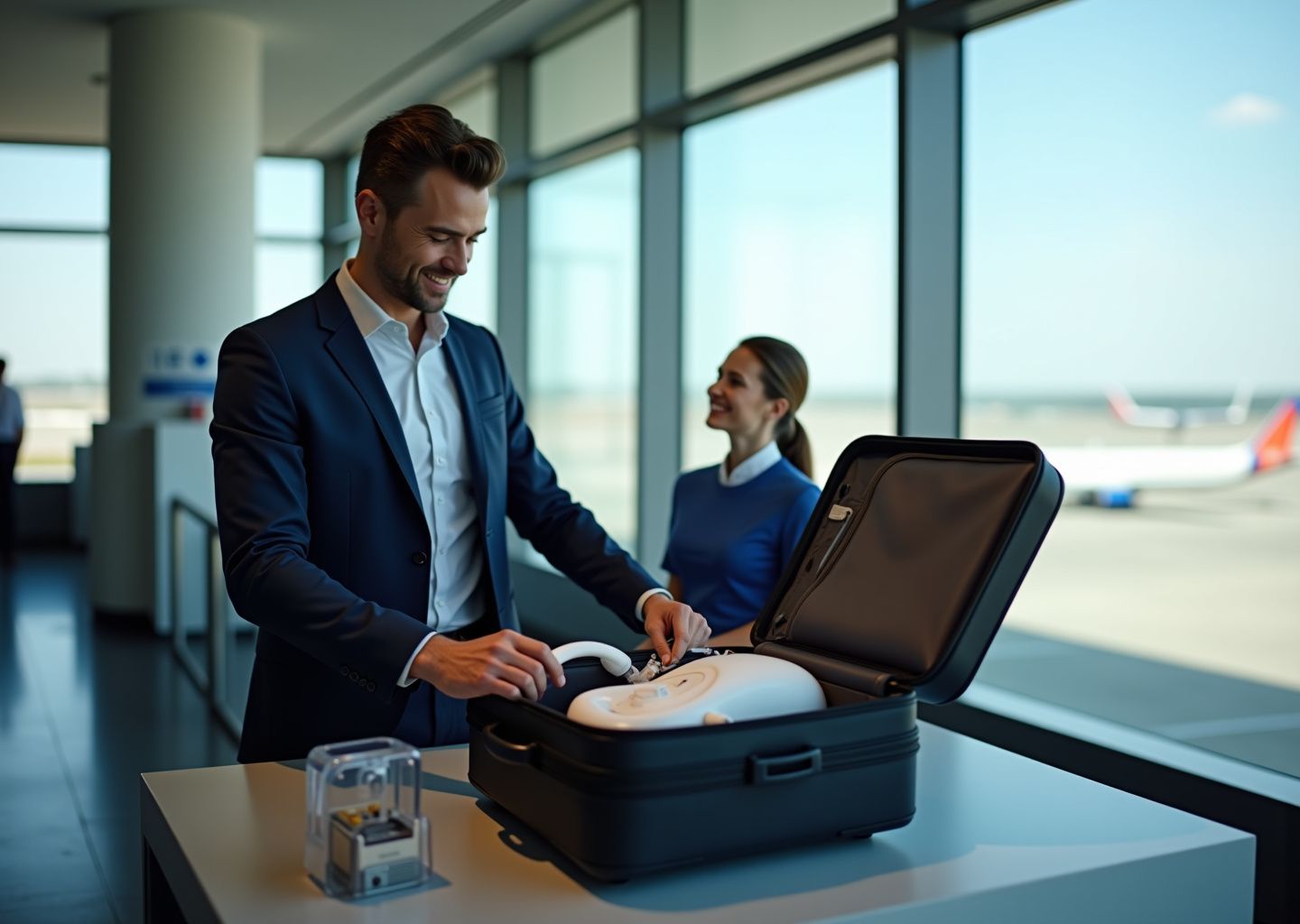
Traveling with CPAP should be simple and stress free. This article explains current TSA and airline rules, battery limits, packing checklists, in‑airport screening tips, and how to use your CPAP on board or at your destination. Follow these practical, up‑to‑date steps to protect your device, maintain therapy, and avoid surprises at security and gates.
What TSA and US aviation rules mean for CPAP travelers
Navigating the airport with a CPAP machine can feel daunting, but understanding the rules is the first step to a stress-free journey. The most important thing to know is that under both Transportation Security Administration (TSA) and Federal Aviation Administration (FAA) guidelines, your CPAP, BiPAP, or portable ventilator is classified as a durable medical device. This special status has significant, positive implications for you as a traveler in 2025. It means your device is not just another piece of luggage; it’s essential medical equipment, and it’s treated that way.
You are permitted to transport your CPAP machine in either your carry-on or checked luggage. However, the universal recommendation from the TSA, airlines, and sleep therapy experts is to always keep it with you in your carry-on bag. Placing it in checked luggage exposes it to risks of damage from rough handling, extreme temperature changes in the cargo hold, or worse, getting lost or delayed. If your checked bag doesn’t arrive with you, you could be left without your therapy for a night or more. Keeping it in your carry-on ensures it stays safe, secure, and with you at all times. As a medical device, it typically does not count against your airline’s carry-on or personal item allowance, though confirming this with your specific airline is a crucial step.
When you reach the security checkpoint, you will need to remove the CPAP machine from its travel case and place it in a separate bin for X-ray screening, just like you would with a laptop. The plastic tubing and mask can usually remain in the travel bag. While the X-ray scanners are generally considered safe for electronic devices, you have the right to request a manual inspection instead. If you prefer not to have your device go through the X-ray machine, simply inform the TSA officer. They will conduct a visual inspection and may need to swab the device for traces of explosives. This is a standard procedure, and you can help by having the device easily accessible. You may also be asked to power it on to demonstrate it is a functioning medical device.
For travelers who need extra assistance or have concerns about the screening process, the TSA Cares program is an invaluable resource. This helpline provides travelers with disabilities and medical conditions information about what to expect at the checkpoint. You can call or submit a form online to ask specific questions or request the assistance of a Passenger Support Specialist at the airport. It is highly recommended to contact TSA Cares at least 72 hours before your flight to ensure they can accommodate your request.
It’s vital to remember that you are navigating two sets of rules. The TSA governs what happens at the security checkpoint, while the FAA and individual airlines govern what happens on the aircraft. While the TSA allows your CPAP, your airline has its own policies regarding carry-on size, in-seat power availability, and requirements for in-flight use. You must check your airline’s website for their specific policies on medical devices well before your travel date.
This is especially critical when it comes to batteries. The intersection of TSA and FAA rules is most apparent here. The FAA has strict regulations concerning lithium-ion batteries due to their potential fire risk. The most important rule is that all spare lithium-ion batteries must be in your carry-on luggage; they are strictly forbidden in checked bags. The terminals of spare batteries should also be protected from short-circuiting by keeping them in their original retail packaging, in a battery case, or by placing tape over the terminals. The FAA provides specific guidance on its Pack Safe page about the Watt-hour limits and carry-on requirements for lithium batteries. Similarly, the TSA officially states that medical devices like CPAP machines are allowed through security checkpoints after they are screened. Verifying these pages before you fly ensures you have the most current information for 2025.
To make sure you’re fully prepared, here is a quick checklist of actions to take in the week leading up to your flight.
- Verify Device Information: Locate the serial number and technical specifications for your CPAP machine and any external batteries. Take a clear photo of the labels with your phone for easy access.
- Confirm Airline Policy: Visit your airline’s website and search for their specific policy on “medical devices” or “assistive devices.” Check for any forms that need to be filled out, especially if you plan to use the CPAP in-flight.
- Contact TSA Cares (If Needed): If you have any concerns about the screening process or require special assistance, contact TSA Cares at least 72 hours before your flight.
- Assemble Your Travel Kit: Gather your CPAP machine, mask, tubing, power cords, and any batteries. The next chapter will cover exactly how to pack these items for a smooth and safe journey.
How to pack CPAP gear for security screening and safe transit
Proper packing is your first line of defense against travel-related disruptions to your sleep therapy. A well-organized bag not only protects your expensive equipment but also streamlines your experience at the TSA security checkpoint. Think of this as building a travel-ready system for your CPAP, ensuring everything arrives safely and works perfectly when you do.
Choosing the Right Bag for Your CPAP
Your CPAP machine likely came with a manufacturer-provided travel case. These are often the best option because they are custom-padded to fit your specific device, mask, and primary accessories. They are designed to be compact and protective. If you find the original case bulky or want to consolidate, consider a padded compartment within your main carry-on backpack or roller bag. The key is protection. The bag must prevent the machine from being crushed or damaged by shifting items. Ensure any bag you choose fits standard airline carry-on dimensions, allowing it to be stored securely under the seat in front of you. Placing it under the seat is always preferable to the overhead bin to prevent it from being damaged by other passengers’ heavy luggage.
What to Pack in Your Carry-On
Your carry-on bag is the only safe place for your essential CPAP equipment. Never place the machine itself or its critical components in checked luggage. Your carry-on should contain everything you need for at least a few nights of therapy in case your checked bags are delayed.
- CPAP Machine
The core of your therapy system. - Mask and Headgear
Pack your primary mask and its complete headgear assembly. - Tubing or Hose
The hose connecting your mask to the machine. - Power Supply
This includes the power brick and the wall cord. - External Batteries
All lithium-ion battery packs must be in your carry-on. Pack them with terminals protected to prevent short circuits, either by taping over them or keeping them in their original retail packaging or a separate plastic bag. - Battery Documentation
If you are traveling with a larger lithium-ion battery (between 100 and 160 watt-hours), print out the airline’s approval email and the battery’s specification sheet. - Humidifier Chamber
The chamber must be completely empty and dry. TSA may confiscate the device if it contains water. Plan to purchase distilled water at your destination; most pharmacies and grocery stores carry it.
What to Leave Out of Checked Luggage
While it might be tempting to check some items to save carry-on space, the risks of damage, loss, or regulatory violations are too high. The TSA strongly recommends keeping your CPAP machine with you as a carry-on. Baggage handlers are not gentle, and the risk of your machine being lost or delayed is a serious threat to your health. Specifically, never pack these items in your checked bags.
- Your CPAP Machine
This is non-negotiable. It is a critical medical device and must remain with you. - Lithium-Ion Batteries
FAA regulations strictly prohibit spare or primary lithium-ion batteries in checked luggage due to fire risk. All batteries must be in your carry-on. - Delicate Masks
If you must pack a spare mask in your checked bag, ensure it is in a hard, protective case. A soft-sided bag offers little protection against the weight of other luggage.
Labeling and Documentation
While the TSA does not legally require a prescription or a doctor’s note to travel with a CPAP machine, carrying documentation can be helpful, especially with airline gate agents or international customs officials. A simple medical identification tag on your CPAP bag is also a smart idea. If you choose to carry a letter, it should be straightforward.
A helpful doctor’s note could include the following information.
To Whom It May Concern,

[Patient's Full Name] is under my care for Obstructive Sleep Apnea and is required to use a Continuous Positive Airway Pressure (CPAP) device for medical necessity.

Device: [Manufacturer and Model, e.g., ResMed AirSense 11]
Serial Number: [Device S/N]

This medical equipment and its accessories, including any battery packs, must be carried with the patient at all times. Please extend any necessary assistance to facilitate travel with this device.

Sincerely,
[Doctor's Name and Contact Information]
Preparing for the Security Checkpoint
When you arrive at the TSA checkpoint, you will need to remove the CPAP machine from its travel case and place it in a separate bin for X-ray screening. You can leave smaller accessories like the mask and tubing in the bag. To maintain hygiene, you can place your machine inside a clear plastic bag before putting it in the bin. Be prepared for a TSA officer to ask you to power the device on. This is a rare request, but it can happen. Having your power cord easily accessible will make this process quick and simple.
Spares, Hygiene, and Power Accessories
A small kit with spare parts and cleaning supplies can prevent a minor issue from ruining your therapy. Consider packing extra mask cushions, a spare headgear clip, or travel-sized CPAP mask wipes for daily cleaning. For power, if you are traveling internationally, a universal travel adapter is essential. Research your destination’s plug type (e.g., Type G for the UK, Type F for most of Europe) and ensure your adapter is compatible. Most modern CPAP power supplies can handle a range of voltages (e.g., 100-240V), but always check the label on your power brick to confirm. Some newer travel CPAPs can be powered via a high-wattage USB-C connection, offering more flexible charging options.
Sample Packing Checklist
- CPAP machine in a padded carry-on bag
- Mask, headgear, and tubing
- Empty and dry humidifier chamber
- Power cord and adapter brick
- FAA-compliant battery pack (in carry-on)
- Copy of prescription or doctor’s note (optional)
- Spare mask cushion and/or headgear
- CPAP mask wipes or cleaning supplies
- Universal power adapter for international travel
- Medical ID tag on the CPAP bag
Managing batteries power and using CPAP on board
Once your CPAP is packed, the next hurdle is power. Ensuring you have a reliable energy source for your therapy, especially on long-haul flights, requires understanding the rules and planning ahead. Relying on in-seat power is a gamble; a dedicated battery is your best bet for uninterrupted sleep. This section covers everything you need to know about batteries, power calculations, and using your device at 30,000 feet.
Understanding FAA and Airline Battery Regulations for 2025
The Federal Aviation Administration (FAA) sets the rules for lithium-ion batteries on aircraft, which nearly all CPAP batteries are. These rules are based on battery capacity, measured in Watt-hours (Wh). While the TSA handles security screening, it’s the FAA and individual airlines that govern what you can bring and use on board. As of 2025, the limits are generally consistent, but you must verify the policy with your specific airline before you fly.
- Up to 100 Wh: You can bring these batteries in your carry-on luggage without needing airline approval. Most manufacturer-specific travel CPAP batteries fall into this category. You can typically carry multiple batteries, but check your airline’s limit on the number of spares.
- 100.1 Wh to 160 Wh: These larger batteries require airline approval before your flight. You must contact the airline’s special assistance or medical desk at least 48 hours in advance to get clearance. You are usually limited to one or two spare batteries in this range.
- Over 160 Wh: These batteries are generally forbidden on passenger aircraft.
A critical rule to remember is that all spare lithium-ion batteries must be in your carry-on luggage. Never place them in checked bags. The terminals must be protected from short-circuiting, either by keeping the battery in its original retail packaging, in a protective case, or by placing tape over the terminals.
How to Calculate Your Battery Needs
To know if you need airline approval, you must find your battery’s Watt-hour rating. If it isn’t printed on the battery, you can calculate it yourself. You’ll need to know the battery’s Voltage (V) and Amp-hours (Ah), or the CPAP machine’s power consumption in Watts (W) and how many hours you need it to run.
Use one of these simple formulas:
Watt-hours (Wh) = Volts (V) × Amp-hours (Ah)
or
Watt-hours (Wh) = Watts (W) × Hours of Use (h)
Let’s look at two common scenarios.
Example A: Travel CPAP on an 8-Hour Overnight Flight
Your travel CPAP machine uses about 15 watts without the humidifier. You need it for a full 8 hours of sleep.
Calculation: 15 Watts × 8 Hours = 120 Wh
A 120 Wh battery falls into the 100.1–160 Wh category. You will need to contact your airline for pre-approval to bring this battery on board.
Example B: Full-Size CPAP for a Short Nap
Your home CPAP machine uses 40 watts with low humidity settings. You want to use it for a 2-hour nap on a daytime flight.
Calculation: 40 Watts × 2 Hours = 80 Wh
An 80 Wh battery is under the 100 Wh threshold. You can bring this in your carry-on without needing to notify the airline.
Choosing the Right Power Source
You have two main options for powering your CPAP in the air: manufacturer-approved batteries or third-party power stations. Manufacturer batteries are designed specifically for your device, ensuring perfect compatibility and voltage. They are often the easiest choice for navigating airline rules. Third-party power stations offer more flexibility and can power other devices, but you must ensure they meet specific technical requirements. Look for a unit with a regulated 12V DC output to power your CPAP efficiently, and if you must use the AC plug, ensure it has a pure sine wave inverter to avoid damaging your machine’s motor. Always use the correct DC adapter cable for your specific CPAP model; never attempt to create your own wiring.
Using Your CPAP On Board: Rules and Reality
Getting permission to bring a battery on board is different from getting permission to use your CPAP during the flight. You must notify the airline in advance (typically 48-72 hours) of your intent to use a medical device in-flight. Some airlines may ask for a form to be completed by your doctor.
While many modern aircraft have in-seat power outlets, they are notoriously unreliable. They may not provide enough consistent wattage for a CPAP, may be shared with other seats, or may be turned off during taxi, takeoff, and landing. For this reason, you should never rely on them as your primary power source. The best practice is to use your own FAA-compliant battery. This makes you self-sufficient and ensures your therapy is not interrupted if the seat power fails or is unavailable. For more details on airline-specific policies, resources like the CPAP Travel Rules 2026 guide can provide additional context.
Your In-Flight Power Decision Flow
Use this simple guide to prepare for your flight.
- Is my flight long enough that I’ll need to sleep? If yes, you need a power plan. If no, you can likely skip bringing a battery.
- Calculate the Watt-hours needed for your therapy duration. Does the required battery fall under 100 Wh or between 100-160 Wh?
- Contact your airline’s medical desk at least 72 hours before your flight. Ask these key questions:
- What is your policy for carrying on and using a CPAP machine in-flight?
- I have a lithium-ion battery with a [Your Wh] capacity. What is the approval process for this battery?
- Do you require any specific medical forms to be completed?
- Can you confirm my reservation is noted for in-flight use of a medical device?
- When shopping for a battery, look for these features: FAA-compliant (under 160 Wh), clearly labeled with its Wh or V/Ah rating, includes the correct DC output port and cable for your CPAP model, and has safety features like short-circuit and overcharge protection.
Frequently Asked Questions
Navigating airport security and airline rules with a CPAP machine can feel daunting, but it doesn’t have to be. With a little preparation, you can get through the process smoothly. Here are answers to the most common questions we hear from travelers about flying with their sleep therapy equipment in 2025.
Do I need a doctor’s note or special approval to bring my CPAP?
No, the Transportation Security Administration (TSA) does not require a doctor’s note or prior approval for you to bring a CPAP machine through security. It is recognized as a necessary medical device. However, carrying documentation can be very helpful, especially with airline staff or during international travel where agents may be less familiar with the equipment. A note can quickly clarify the purpose of the device and prevent delays.
- Action Item: Pack a copy of your prescription or a letter from your doctor on their letterhead. It should state that the device is medically necessary for the treatment of sleep apnea.
What if my CPAP is damaged during the screening process?
While rare, damage can happen. If you believe a TSA officer damaged your device, report it immediately before leaving the security checkpoint. Ask to speak with a TSA supervisor and request a property damage claim form. Document the damage with photos on your phone if possible, and note the time, airport, and checkpoint location.
- Action Item: If you suspect damage, do not leave security. Speak to a supervisor on site and file a claim right away.
When should I contact TSA Cares or my airline’s medical desk?
Proactive communication is key. Contact TSA Cares at least 72 hours before your flight if you have a medical condition, disability, or any concerns about the screening of your CPAP. They can provide information and arrange for a Passenger Support Specialist to assist you at the airport. You should contact your airline’s medical desk if you need to use your CPAP on the plane or need to get approval for a battery over 100 Wh.
- Action Item: For screening questions, call TSA Cares. For in-flight use or battery approval, call your airline’s medical desk.
Troubleshooting Common Screening Snags
If your CPAP is flagged for additional screening, it’s usually for a simple reason. The dense motor can appear opaque on an X-ray, which automatically triggers a closer look. An ETD swab test typically resolves this in a minute or two. If you’re asked to turn the device on and it doesn’t work, calmly check that your power cord is fully connected or that your battery is properly seated and charged. Having your equipment organized makes these quick checks much easier.
Final Conclusion and next steps
Navigating the world of air travel with a CPAP machine can feel complex, but it boils down to one central theme: preparation. The rules and procedures we’ve covered are not designed to be obstacles, but rather a framework to ensure safety and security for everyone on board. By understanding this framework and planning ahead, you can transform potential travel stress into a smooth, predictable process. The most critical takeaway is to treat your CPAP device not as luggage, but as the essential medical equipment it is. This single shift in mindset informs every decision you make, from packing to boarding.
The non-negotiable first step is to always pack your CPAP machine and all its essential accessories in your carry-on bag. The Transportation Security Administration (TSA) recognizes it as a medical device, meaning it does not count against your carry-on allowance. This policy is your greatest asset. Relying on checked baggage introduces unacceptable risks of damage from rough handling, extreme temperature changes in the cargo hold, or the complete loss of your device. A lost suitcase is an inconvenience; a lost CPAP machine is a medical emergency that derails your trip and jeopardizes your health. Keeping it with you ensures it arrives safely and in working order, ready for you to use on your first night away.
Equally important is arming yourself with the right documentation. While a doctor’s note isn’t always mandatory for security screening, having one that clearly states the medical necessity of your CPAP therapy is invaluable. It can resolve any confusion with airline staff or security agents swiftly. This documentation should also include the specifications for any lithium-ion batteries you’re carrying, particularly the Watt-hour (Wh) rating. Agents are trained to look for this information. Having it printed out or easily accessible on your phone, along with a copy of your prescription, demonstrates that you are a prepared and informed traveler. This proactive step prevents delays and ensures you can clearly communicate the nature and compliance of your equipment.
Remember that the TSA and your airline are two separate entities with different sets of rules. The TSA governs the security screening process, while the airline dictates what is permissible on their aircraft. Before you even book your flight, you should review your specific airline’s policy on portable electronic medical devices. Some may require 48-hour advance notification for in-flight use, while others might have specific forms to fill out. Never assume one airline’s policy is the same as another’s. A quick visit to their website or a call to their special assistance desk clarifies everything, especially if you plan to use your device during the flight. This is particularly crucial for long-haul or red-eye flights where uninterrupted therapy is essential. For more general guidance, resources like the CPAP air travel guide from ResMed can also provide a helpful overview.
Finally, if you require therapy during your flight, investing in an FAA-compliant travel battery is the only reliable solution. Aircraft seat power ports are notoriously unreliable and are often not available or approved for use with medical devices. A dedicated battery gives you autonomy and peace of mind. Ensure your battery is under the 160Wh limit, with most falling comfortably under 100Wh. Remember that any battery over 100Wh will likely require airline pre-approval. Always carry batteries in your carry-on luggage and protect the terminals from short-circuiting by taping them or keeping them in their original packaging.
To put all this information into action, here is a final checklist to complete before your next trip.
- Verify Your Battery and Power Needs.
Check the Watt-hour (Wh) rating on all your CPAP batteries. If a battery is between 100Wh and 160Wh, contact your airline for approval. Confirm you have the correct power adapters for your destination. - Prepare Your Medical Documentation.
Obtain a letter from your doctor stating your need for CPAP therapy. Print a copy of your prescription and the FAA compliance letter for your specific CPAP model. Have the battery specifications handy. - Pack Smart Spares.
Include a spare mask, cushion, and headgear in your carry-on. These small items are difficult to replace while traveling and are critical if a part breaks or gets lost. - Empty Your Humidifier.
Before you leave for the airport, make sure your humidifier water chamber is completely empty and dry. This prevents spills during screening and protects the internal electronics of your machine. - Notify the Right People.
If you have any concerns about the screening process, contact TSA Cares at least 72 hours before your flight. If you plan to use your CPAP on the plane, you must call your airline’s medical desk to register your device and confirm their procedure.
Traveling with your CPAP machine is entirely manageable. It simply requires a bit of foresight. By following these guidelines, you ensure your journey is as restful as your destination. Staying compliant with regulations and being prepared not only makes for a smoother airport experience but also protects your health, allowing you to continue your essential sleep therapy without interruption, no matter where you go.
Sources
- Traveling with CPAP Machine: Essential Checklist for Hassle-Free … — Though TSA X-ray screening is generally safe for CPAP devices, you can place your device in a clear plastic bag before screening to maintain …
- TSA CPAP Tips: Guide to Flying and Traveling with Your CPAP — Most consider them as medical devices, meaning they don't count against your carry-on limit. Make sure to bring the appropriate power adapters …
- What You Need to Know About Traveling With a CPAP Machine — The TSA recognizes CPAP machines as essential medical devices. As a result, all major airlines must allow you to bring one on board, and use …
- CPAP air travel: What you should know – Resmed — The TSA goes on to recommend bringing your CPAP machine on the plane as a carry-on. After all, if you check it, and your baggage is misplaced, “ …
- CPAP Travel Rules 2026: TSA & FAA Battery Limits — TSA Rules: CPAP machines are treated as medical devices and aren't counted as carry-on luggage. Be prepared for additional screening, including …
- Traveling with Medication and Medical Equipment | United Airlines — You can bring one as a carry-on for free if it meets TSA guidelines and fits in the overhead bin. If it doesn't fit, you can still transport it as a checked …
Legal Disclaimers & Brand Notices
The information provided in this article is for informational and educational purposes only and is not intended as a substitute for professional medical advice, diagnosis, or treatment. Always seek the advice of your physician or other qualified health provider with any questions you may have regarding a medical condition, the use of a CPAP machine, or specific travel requirements related to your health.
This content focuses on general guidelines provided by the Transportation Security Administration (TSA) and the Federal Aviation Administration (FAA). Regulations are subject to change, and travelers should always verify the most current rules directly with the relevant governmental agencies and their specific airline before travel.
All product names, logos, and brands mentioned, including those referenced in external links (e.g., ResMed), are the property of their respective owners. Their use does not imply endorsement or affiliation.